
Chinese checkers: play free online and learn the rules
Play Chinese checkers (Sternhalma) online for free against the computer or a friend, right in your browser, with no account or download. The game is played on a six-pointed star board of 121 holes, not on dark squares. There is no capturing at all: marbles hop over one another, but a jumped marble stays right where it is.
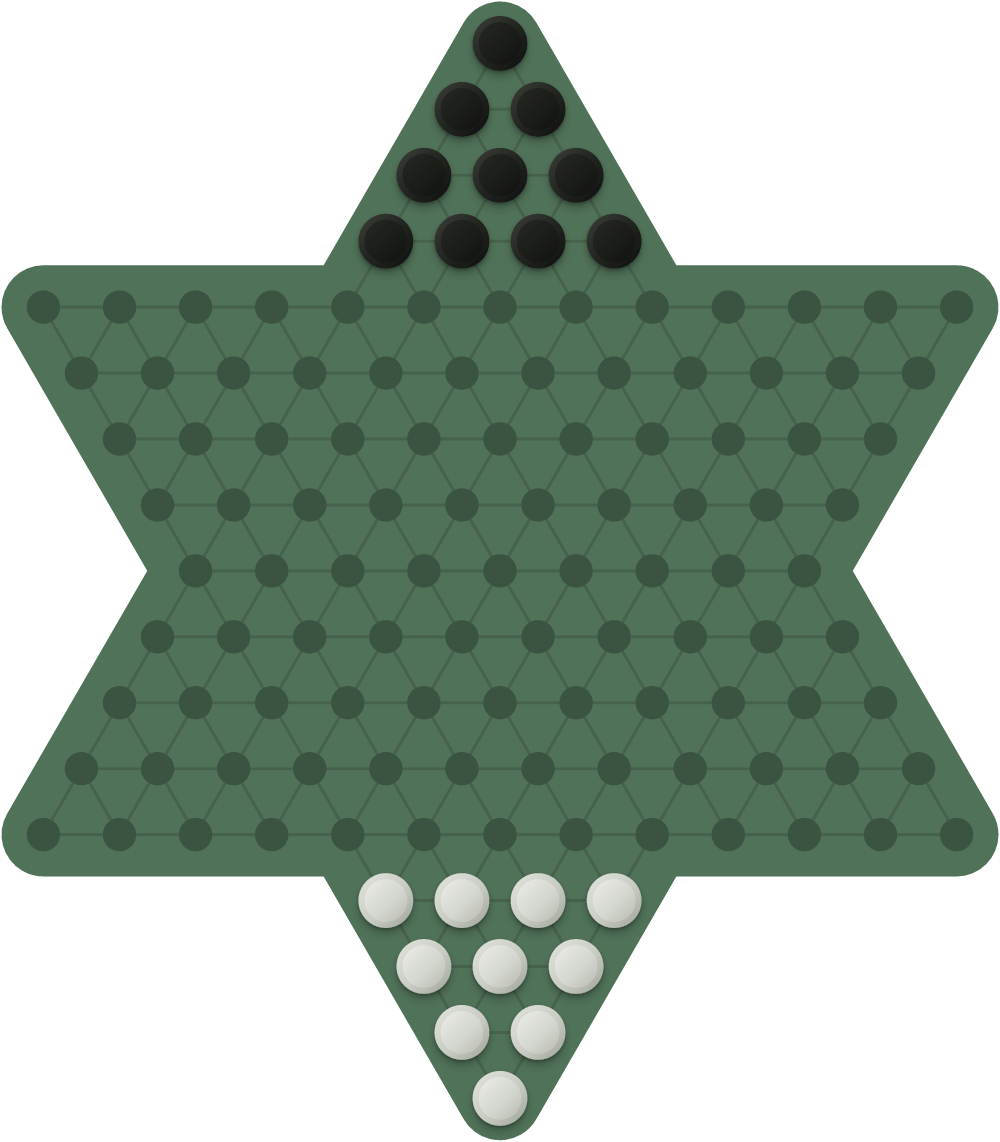
You play the marbles at the south point of the star; the computer plays the marbles at the north point, directly across the board. Whoever moves all ten marbles into the point opposite their own start wins.
1 · Chain jump
Jump a marble into the empty hole beyond, then keep jumping in the same turn.
2 · No captures
Hopped marbles, yours or theirs, stay on the board.
3 · Goal
Move all 10 marbles to the opposite point to win.
Nobody is removed from the board. You win by relocating your whole army, not by capturing the other side's.
The Chinese checkers board and marbles
The board is a six-pointed star with 121 holes: a hexagon in the middle and a triangular point of ten holes on each of its six sides. Each player's ten marbles start in one point, and the goal is the point directly across the board.
Checkerso plays the two-player version: you start at the south point and the computer at the north point, and the other four points stay empty. Marbles move in any of the six directions, including backward and sideways, so a marble can go wherever a step or a hop lets it.
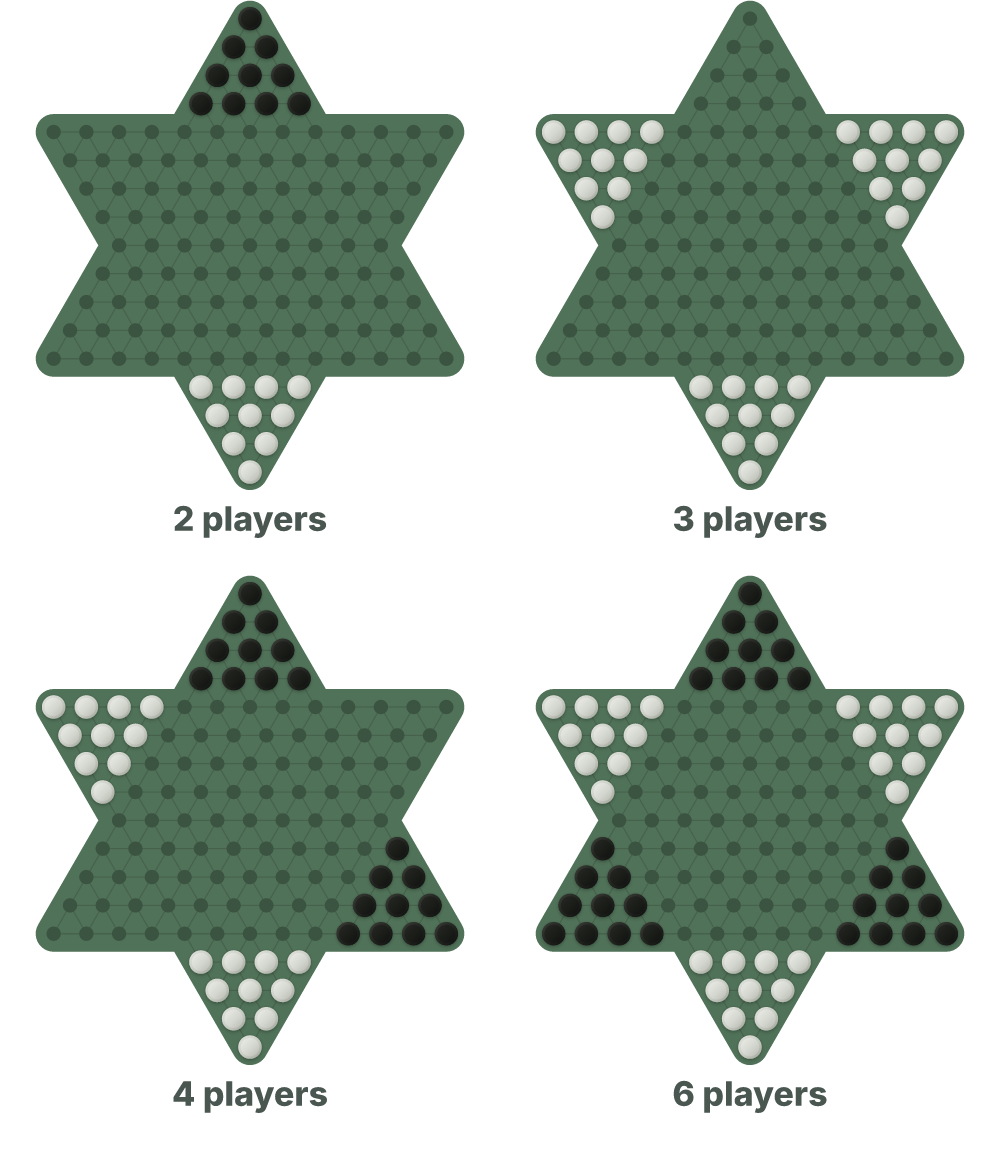
Chinese checkers setups for 2, 3, 4, and 6 players
Everyone has ten marbles, and everyone races to the point directly across the star. The number of players decides which points are filled. Two players take two opposite points. Three players take every second point, so each one's goal is an empty point. Four players take two pairs of opposite points, and six players fill the whole star. Checkerso plays the two-player setup.
How to play Chinese checkers
- Each side starts with ten marbles filling one point of the star. The point directly across the board is the goal.
- Take turns. On your turn, move one marble: step one hole in any of the six directions onto an empty neighbor.
- Or hop over one adjacent marble — yours or the computer's — into the empty hole directly beyond it, in a straight line. If another hop is open from there, you may keep going in the same turn.
- Nothing is captured. The first player to move all ten marbles into the opposite point wins.
Chain jumps are one turn
If the hole beyond your landing spot also has a marble you can hop, you may keep going — over marbles in different directions, not just a straight line — all inside the same turn.
You choose how far the chain runs. Tapping the first empty hole after one hop ends your turn there; tapping a hole three hops away plays the whole chain at once. Nothing forces you to keep jumping.
One house rule: no backing out of home
Once a marble reaches the point opposite your start, it may only move to another hole inside that same point — it cannot step or jump back out. This keeps a finished game from being reopened by a stray retreat, and is the only movement restriction on this board beyond the six-direction hop rule above.
Bring up the marbles left behind
A marble stuck at the back is the one that costs you the race. Move stragglers forward before the others get far ahead of them, so every marble can be part of a chain.
Use the other side's marbles too
You may hop over any marble, yours or the computer's. A line of the computer's marbles is a ladder for you as well.
Build a hopping ladder
A short line of your own marbles lets a single piece chain several hops down the board in one turn — often faster than three separate single-step moves.
Don't block your own lane
A marble sitting where a chain jump would land stops the chain cold. Leave the hole beyond a hop empty until the piece that needs it arrives.
Race, don't fight
There is nothing to capture, so a marble stuck defending accomplishes nothing. Every move should move a piece closer to the opposite point.
Compared with the draughts games on Checkerso
American checkers, Pool checkers, and International draughts are all capturing games on a dark-square grid. Chinese checkers shares none of that: no captures, no squares, no forced jumps — the star board, with its single steps and hops, is its own game.
International draughts if you want flying kings and mandatory captures on a 10×10 board instead.
Frequently asked questions
How do you play Chinese checkers?
Each side has ten marbles on one point of the star. On your turn, move one marble: step to an empty neighboring hole, or hop over an adjacent marble into the empty hole directly beyond it, and keep hopping in the same turn if you can. Nothing is captured. The first player to move all ten marbles into the opposite point wins.
How do you play Chinese checkers with 2 players?
Each player takes one point of the star, with ten marbles filling it, and the point across the board is the goal. Take turns moving one marble a step or a hop, chaining hops when you can. The first player to fill the opposite point wins. This is the setup Checkerso plays.
Can I play Chinese checkers against the computer?
Yes. A new game is against the computer, and you choose Easy, Medium, or Hard. It is free, with no account or download.
Can I play Chinese checkers online with a friend?
Yes. Choose New game, then Play a Friend, and send your friend the link. You each play on your own phone or computer, with your marbles at the bottom, and neither of you needs an account. The player who made the game plays white and moves first. For two people on one device, choose 2 Player (Same Device) instead.
Is Chinese checkers from China?
No. It descends from Halma, a board game of the 1880s, and appeared as Stern-Halma in Germany in 1892. The name Chinese checkers was adopted in the United States in the late 1920s as a marketing name.
Who invented Chinese checkers?
The game began as Halma, devised in 1883 or 1884 by George Howard Monks, an American surgeon. The star-board version appeared in Germany in 1892 as Stern-Halma, and in 1928 the American Pressman company marketed it as Chinese checkers.
What is Chinese checkers?
Chinese checkers, also called Sternhalma, is a board game on a six-pointed star with 121 holes. Each player has ten marbles that step or hop across the board. Nothing is captured; the first player to move all ten marbles into the opposite point wins.
Can you move backwards in Chinese checkers?
Yes. A marble can step or hop in any of the six directions, forward, backward, or sideways. On Checkerso there is one restriction: a marble that has reached the opposite point can only move to another hole in that point, not back out.
How many marbles and holes are there in Chinese checkers?
The board has 121 holes. Each player has ten marbles. The full game has six colors, so 60 marbles, but with two players only two opposite points are in play, and Checkerso plays that version.
How many people can play Chinese checkers?
Two, three, four, or six, each with ten marbles. Two players take opposite points, three take every second point (each goal is then an empty point), four take two pairs of opposite points, and six fill the whole star. Checkerso plays the two-player game.
How do you win at Chinese checkers?
Move all ten of your marbles into the point opposite your start before the computer does. Chain jumps get marbles across fastest, so build lines of marbles to hop along and bring up the ones left behind.
Does a jumped marble get captured in Chinese checkers?
No. Hopping over a marble in Chinese checkers never removes it — that piece stays on the board exactly where it was. Only draughts-family games on Checkerso have captures.
Can you jump over your own marbles in Chinese checkers?
Yes. You can hop over any adjacent marble, yours or an opponent's, as long as the hole directly beyond it is empty. Hopping never removes the marble you jump.
Can you double jump in Chinese checkers?
Yes. After one hop, the same marble can hop again in the same turn, over a different marble and in any direction, for as many hops as the board allows. Players call this a chain jump or multi-jump. On Checkerso every hole a chain can reach is offered, so you choose where it stops.
Do I have to keep jumping once I start a chain?
No. Each hole a chain jump can reach — including the very first landing — is offered as its own legal move. Tap the one you want; you decide how many hops to take.
Can I move through the four empty points on the sides?
Yes. With only two players, the northeast, northwest, southeast, and southwest points of the star are unused, and this board does not stop you from stepping or jumping through them.
Does difficulty change the rules?
No. Easy, Medium, and Hard only change how far the computer's search looks ahead. Movement, chain jumps, and the win condition are identical on every difficulty.